Yes—travertine and marble can be excellent choices for saltwater pool decks and coping. Choosing a saltwater system does not mean giving up natural stone. The key is selecting suitable stone, an appropriate outdoor finish, and an installation designed for your pool and climate.
Here is how travertine and marble perform around saltwater pools, how concrete coping compares, and what homeowners should know about deposits, sealing, and maintenance.
Saltwater pools contain about one-tenth the salt of seawater
A saltwater pool uses dissolved salt to generate chlorine. Common residential systems target approximately 0.32–0.36% salt (3,200–3,600 ppm), compared with roughly 3.5% in seawater. Your generator’s manual determines the correct operating level for your pool.
That lower concentration is important, but salt remains when splashwater evaporates. Salt sitting on the surface and damage within the stone are different things. Repeated wetting and drying can concentrate salts inside susceptible materials, potentially contributing to surface deterioration—but that is not an inevitable result of saltwater use.
Saltwater pool coping: travertine vs. marble vs. concrete
The table below compares possible issues, not expected outcomes or measured failure rates. For available stone options and profiles, explore our pool coping collection.
What you are comparing | Travertine coping | Marble coping | Concrete coping |
|---|---|---|---|
Salt residue after water dries | Can remain on the surface or in natural openings. | Can remain on the surface and within textured finishes. | Can remain on the surface or in pores. |
Salt crystallization within the material | Possible where salty water enters pores and repeatedly dries. | Possible where salty water enters connected pores or small cracks. | Salt accumulation in pores can contribute to deterioration in susceptible concrete. |
Hard white calcium deposits | Can collect on the surface without indicating damage to the stone. | Can collect on the surface without indicating damage to the stone. | Can collect on the surface without indicating damage to the concrete. |
Pitting, flaking, or surface loss | Possible in susceptible stone—not an automatic consequence of a saltwater pool. | Possible in susceptible stone; the cause should be investigated rather than assumed. | Possible; concrete quality, finishing, curing, and freezing exposure affect performance. |
Stone-care and concrete-maintenance guidance underline why the specific material and exposure matter. Neither supports a blanket claim that one category will always outlast another around a residential saltwater pool.
Before ordering, ask:
“Is this particular coping suitable for my saltwater pool, climate, and installation?”
Our travertine pool coping buyer’s guide and marble pool coping buyer’s guide cover profiles, sizes and installation questions to discuss with your supplier and installer.
White marks do not automatically mean salt damage
A white mark may be something deposited on the coping—not evidence that the coping itself is wearing away. Identify the deposit before choosing a cleaner or treatment.

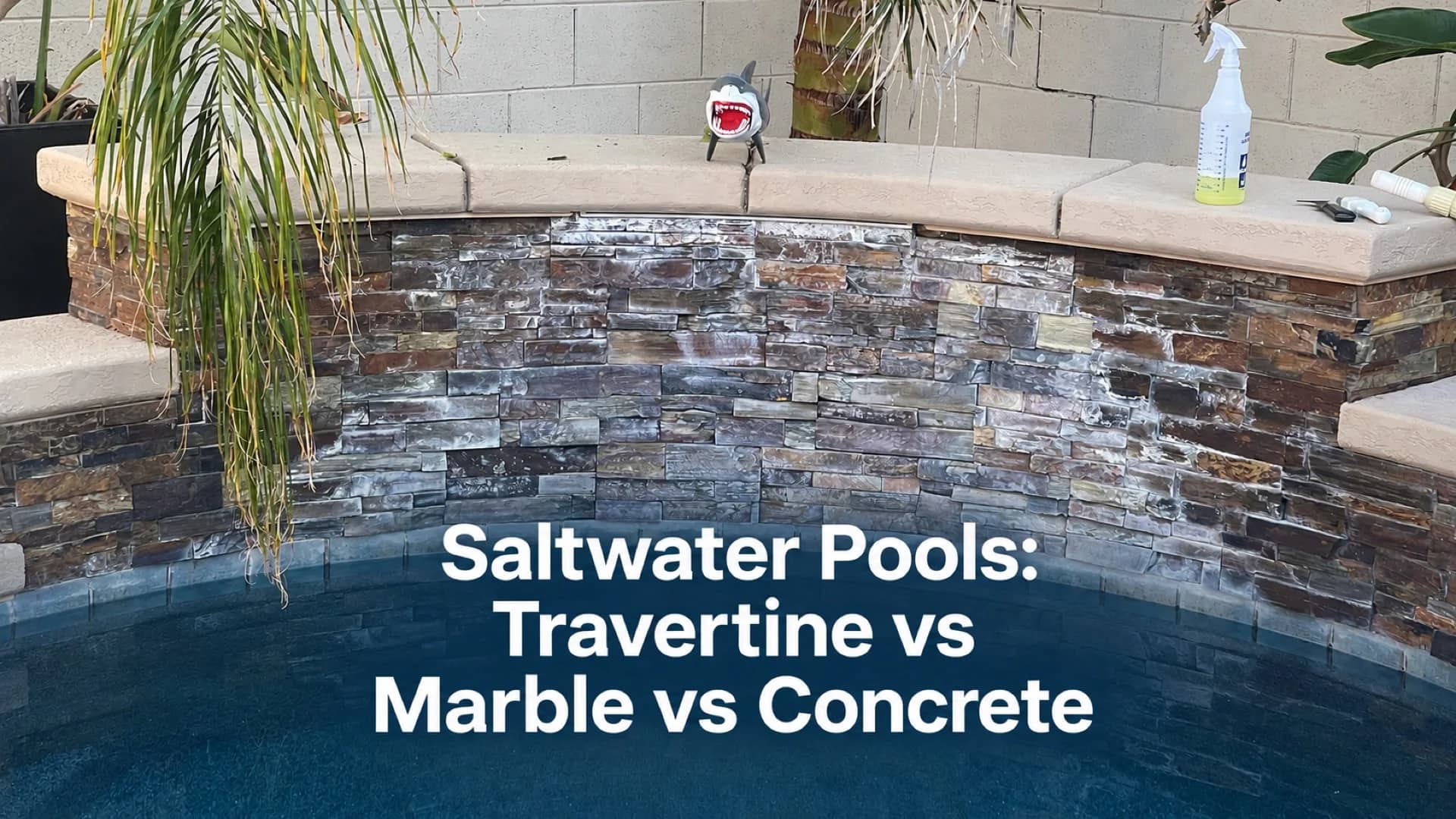
White deposits on a pool wall. The photograph shows surface buildup; its mineral composition and source cannot be confirmed from appearance alone.
What you notice | What it may indicate | Does it prove damage from pool salt? |
|---|---|---|
A light film where splashes dry | Dissolved salts or minerals left after evaporation. | No. Surface residue does not demonstrate material loss. |
A hard, chalky white crust | Calcium scale associated with water chemistry and evaporation. | No. Calcium scale is different from sodium chloride crystals. |
White powder returning near joints or from below | Efflorescence: minerals carried to the surface by moisture moving through the installation. | No. Those minerals may come from the installation rather than the pool. |
New pits, powdering, or flakes coming off the coping | Actual surface deterioration that needs investigation. | No—not by appearance alone. Salt crystallization is one possible cause. |
Large cracks, loose pieces, or shifted coping | A reason to check support, joints, movement, and freezing exposure. | No. Having a saltwater system does not establish the cause. |
These symptoms require different responses. A surface deposit, internal salt crystallization, and freeze–thaw deterioration should not be treated as the same problem.
Calcium scale can also form inside a salt generator and release white flakes into the water. Finding those flakes does not mean your coping is disintegrating.
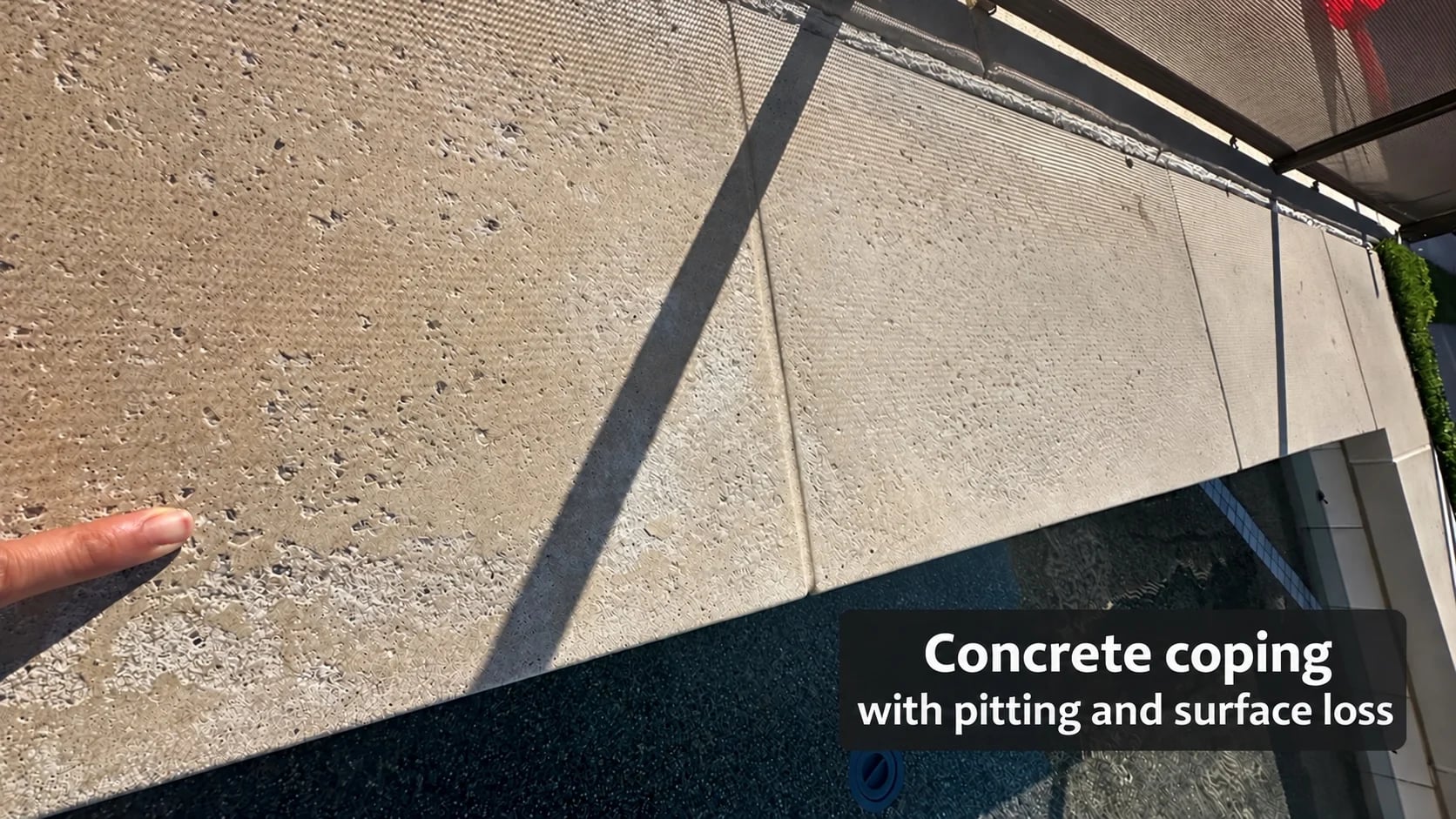
Concrete coping with pitting and surface loss. Photo annotated for material identification. The photograph illustrates the condition, not a confirmed diagnosis of salt damage. Material, installation, water chemistry and exposure all need to be considered.
Coping needs more attention than the rest of the deck
Give particular attention to coping beside entry steps, waterfalls, and spa spillways. Discuss repeated splashing, drainage, and drying with your installer rather than treating every part of the pool surround as the same exposure.
Ask:
“How will this coping handle repeated splashing, shed water, and dry between uses?”
A recommendation for a lightly used patio is not automatically appropriate for a repeatedly wetted pool edge. If you are also choosing an edge profile, compare bullnose and eased-edge pool coping alongside the installation requirements.
See marble and travertine at real saltwater pools
These two projects show different natural-stone approaches to saltwater pool surrounds. Use the photographs to compare color, layout and coping details; they are design examples, not controlled durability tests.
Marble: a continuous deck and coping palette in McLean
At Tundra Grey Harmony in McLean, Virginia, Tundra Grey Marble French Pattern pavers are paired with matching 2-inch eased-edge coping. The marble carries across the deck, pool perimeter and raised spa, creating a continuous grey palette rather than a contrasting border.
Travertine: a textured deck with contrasting coping in Vienna
Vienna Pool Retreat uses Silver Travertine Premium in a French Pattern deck, with bluestone coping defining the pool and spa. This is a travertine pool-deck example—the coping in this project is bluestone, not travertine.
For a closer comparison of their colors and design possibilities, read Silver Travertine vs Tundra Grey Marble.
Do travertine and marble need sealing around a saltwater pool?
Not every natural stone requires sealing, and annual resealing is not a universal rule. Follow the recommendations for the specific stone, treatment, and exposure.
Material | Is sealing automatically required? | What a suitable treatment may help with |
|---|---|---|
Travertine | Not necessarily. Follow the stone supplier’s specifications for the application. | Improved stain resistance and reduced liquid absorption. |
Marble | Not necessarily. Follow the stone supplier’s specifications for the application. | Improved stain resistance and reduced liquid absorption. |
Concrete coping | Follow the manufacturer’s recommendations for the product and climate. | A compatible water repellent may help limit moisture penetration. |
Choose a treatment for its stated purpose and compatibility—not simply because it is called a sealer. Stain resistance and protection against salt-related deterioration are different claims.
For STONELUX materials, check the care recommendations for the specific collection and confirm the treatment with your installer. Sealing advice for one stone should not be assumed to apply to every outdoor material.
Keep maintenance simple
Keep the water balanced. Maintain the generator’s specified salt level alongside the recommended chlorine, pH, alkalinity, and calcium levels. A correct salt reading is only one part of proper pool chemistry.
Rinse ordinary splash residue and clean gently. Use fresh water and a stone-compatible neutral cleaner. For identified efflorescence, remove the dry powder as recommended and investigate recurring moisture rather than repeatedly soaking it.
Avoid vinegar and acid washes on marble and travertine. An unsuitable cleaner can etch the surface, creating damage that was never caused by the pool. Ordinary penetrating sealers do not prevent acid etching.
If you see recurring deposits, actual material loss, or loose coping, have the cause checked before applying stronger chemicals or another treatment.
The bottom line: saltwater and natural stone can work well together
You do not have to choose between a saltwater pool and the travertine or marble you love. Suitable natural stone can work well for both pool decks and coping when selected and installed for the conditions.
Concrete coping has its own maintenance considerations, including surface scaling in freezing conditions. Choosing concrete does not eliminate the need for appropriate materials, installation, and care.
Choose the appearance you want, then confirm the practical details: the right stone, a suitable finish, proper drainage, and a clear maintenance plan.
Ready to compare materials? Request samples to see the color and finish in person, or contact STONELUX with your pool location and project details.
Further reading
For general guidance, see the Natural Stone Institute’s care and cleaning advice, Pentair’s pool-water calculators, and the NRMCA explanation of concrete surface scaling. These resources do not certify a particular stone, installation or pictured condition.