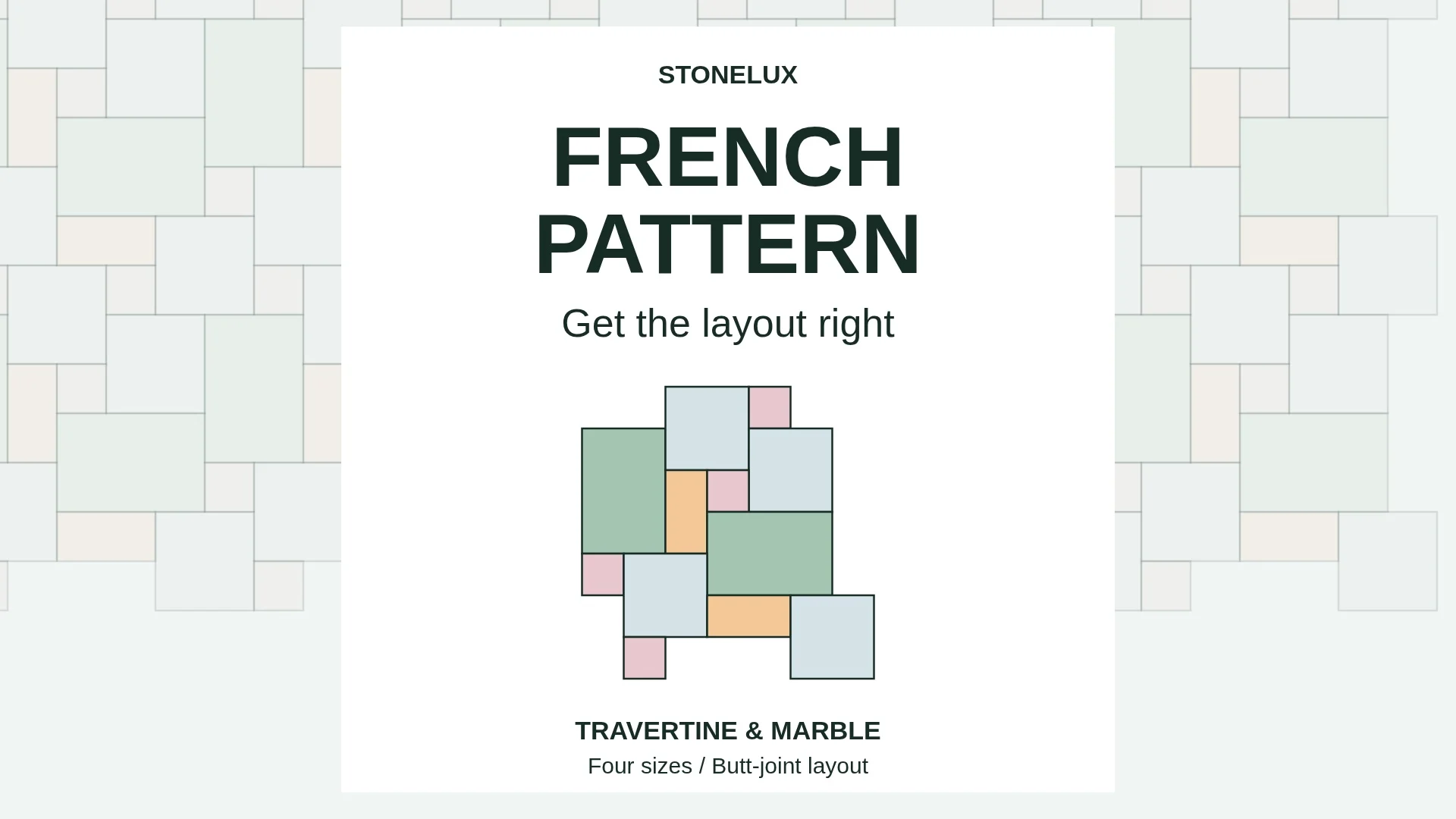
French pattern travertine uses four stone sizes in a repeating, interlocking arrangement: 8 × 8, 8 × 16, 16 × 16 and 16 × 24 inches. The finished surface looks informal, but the quantities follow a fixed balance. Getting that balance right helps keep a pool deck or patio moving without running short of one size.
This guide explains the layout, STONELUX’s 176 sq ft travertine pallet example, joint planning and ordering calculations. It also compares real travertine and marble options for outdoor projects. Start with the diagram, then match the plan to the exact product, installation system and delivered packing list.
Browse French Pattern pavers · Compare stone samples
French pattern layout diagram and four stone sizes
The diagram shows one complete 12-piece repeat containing 16 sq ft of nominal stone area. Its staggered outline interlocks with adjoining repeats; it is not a solid 4 × 4 ft square.
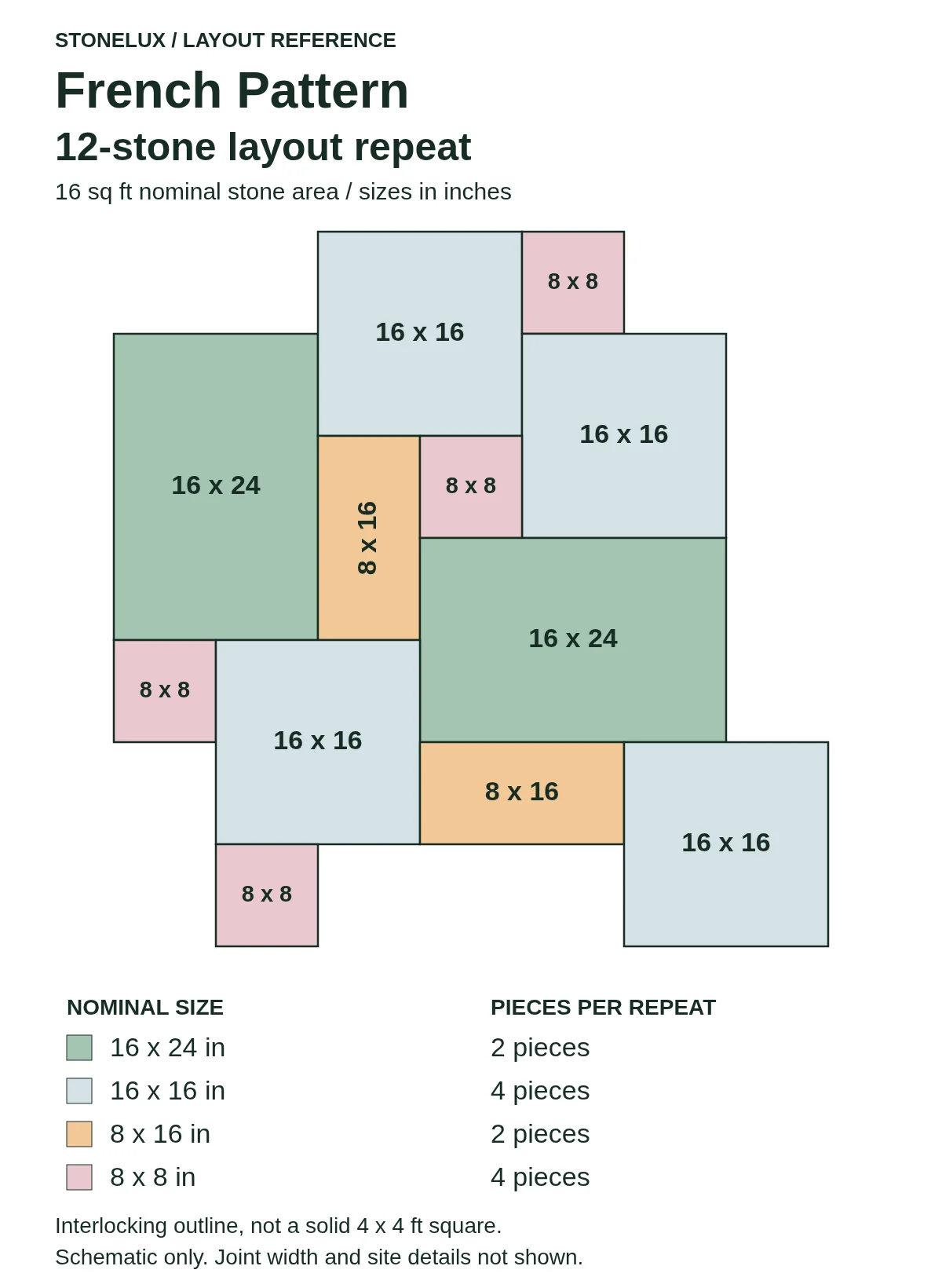
One illustrated repeat: two 16 × 24, four 16 × 16, two 8 × 16 and four 8 × 8 inch pieces. Colors identify sizes. Lines show stone edges, not specified joint widths.
Nominal piece counts for the travertine packing example
Nominal face size | 8 sq ft counting set | 16 sq ft illustrated repeat | 176 sq ft travertine pallet |
|---|---|---|---|
16 × 24 in | 1 | 2 | 22 |
16 × 16 in | 2 | 4 | 44 |
8 × 16 in | 1 | 2 | 22 |
8 × 8 in | 2 | 4 | 44 |
Total pieces | 6 | 12 | 132 |
A six-piece counting set represents 8 sq ft; two sets make the illustrated 16 sq ft repeat. The 176 sq ft pallet example therefore contains 22 counting sets or 11 complete repeats. A packing list’s “set” and a drawing’s “repeat” can mean different quantities.
These are nominal dimensions and the travertine packing configuration described here. Check the selected SKU and delivery; do not apply the same piece counts to every marble kit or another supplier’s product. “3 cm” describes thickness, separately from these face sizes.
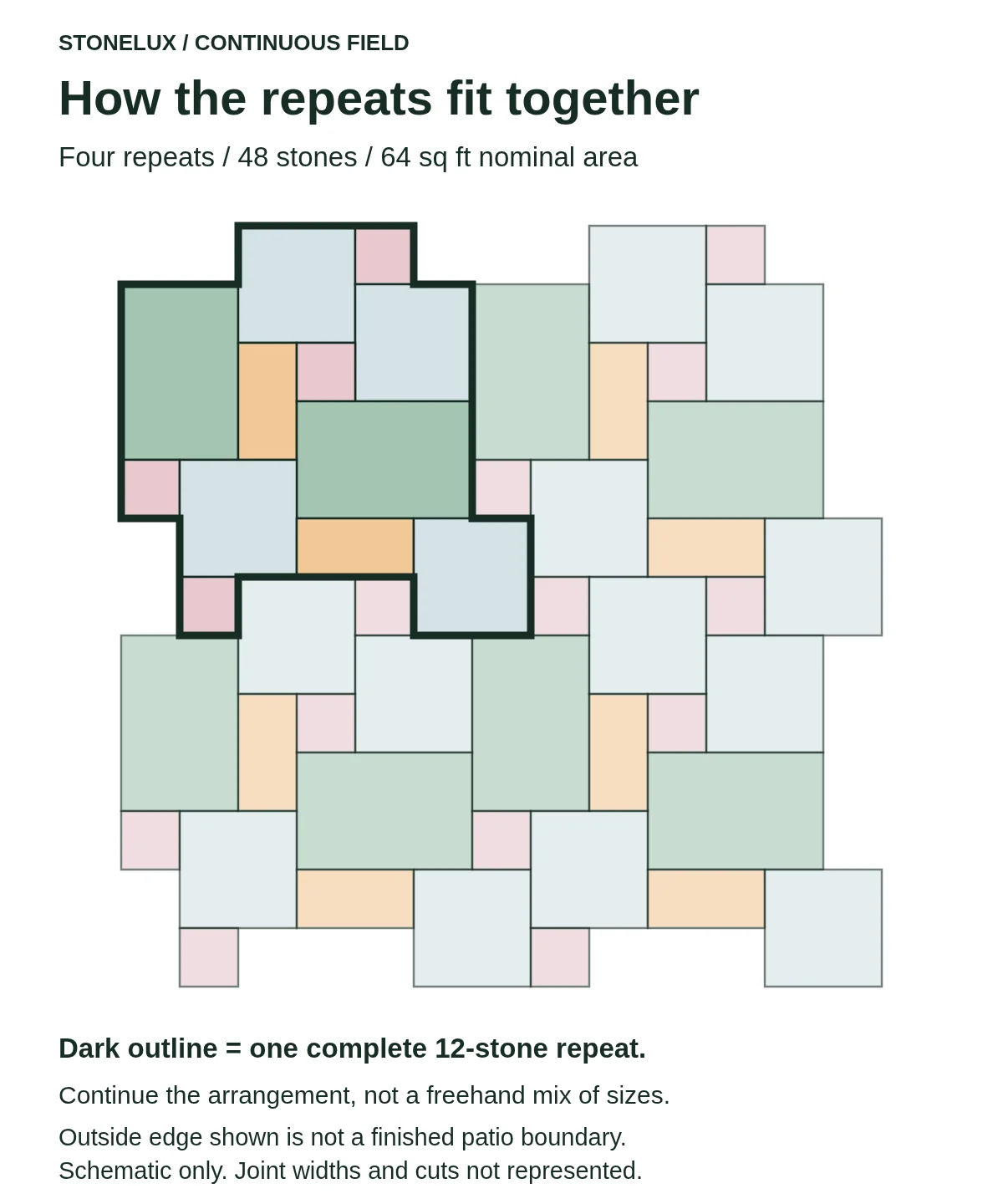
Four repeats contain 48 pieces and 64 sq ft of nominal stone area. The outside outline shows the pattern continuing, not the finished edge of a patio.
Use both drawings together. The first identifies the pieces; the second shows how adjacent repeats connect. Trial-fit adjoining repeats in the chosen orientation before committing the field.
How to lay out French pattern travertine
Begin with a measured plan showing the paving field, pool opening, coping, borders, steps, drains and fixed structures. A repeat drawing organizes the stone; the project plan determines where that repeat starts and ends.
Check the delivery by size. Confirm the product, thickness, finish and packing list. Separate full pieces from offcuts and check actual dimensions before assuming different packs can be combined.
Dry-assemble adjoining repeats. Use stones from the delivery and the approved joint detail. Check every connection between repeats, not just the appearance of one isolated cluster.
Choose the main alignment. Compare the pattern with the house, pool edge and primary viewing direction. Shift the starting point if it leaves awkward slivers at a visible threshold or border.
Agree on a shared crew layout. Mark reference lines and orientation. Separate crews laying the patio and pool surround need a plan for where their work reconnects.
Plan edge cuts separately. Curves, pavilion posts and narrow passages consume pieces differently from an open field. Identify useful offcuts and any size used repeatedly at the perimeter.
Review size consumption as work advances. Compare the remaining piles with the unfinished area. Investigate a shortage while the layout can still be adjusted.
Why one size runs out before the others
The pallet contains twice as many large squares as large rectangles. Using the rectangles wherever they look convenient changes that balance, even if the overall square footage seems sufficient.
For example, suppose the remaining full pieces are two 16 × 24s, eight 16 × 16s, two 8 × 16s and eight 8 × 8s. They make one complete illustrated repeat, leaving four large squares and four small squares. Those leftovers may fit planned edge cuts, but they cannot make another complete repeat.
Count the shortage by size before ordering more stone. Cutting a large paver into smaller pieces is not an automatic replacement: the saw removes material, and the new edges may differ from the factory finish.
Joints, bases and installation requirements
Match the joint detail to the supplied kit
STONELUX’s layout guidance describes a butt-joint set-out for the kits covered here: pieces fit together without an added tile-spacer gap. Confirm that detail for the selected product and delivered dimensions before installation.
The geometry matters. Two nominal 8-inch pieces plus an added joint are longer than one nominal 16-inch piece. Introducing a uniform gap into a kit cut for tight assembly can prevent the repeat from closing. Other manufacturers may supply sets dimensioned for spaced joints; their instructions are not interchangeable.
Tight set-out still allows visible openings at irregular or tumbled edges. It also does not remove the need for designed movement joints, including those required at building interfaces and through the installation. Resolve any conflict between the kit geometry and the selected setting or jointing system before laying.
Travertine and marble require different installation decisions
Decision | Travertine pavers | STONELUX exterior marble |
|---|---|---|
Base and setting method | Confirm the approved system for the specific paver, site and use. Do not infer a sand-set or bonded specification from the pattern name. | Permanent bonded installation over properly designed, cured concrete or an approved cementitious substrate is required. |
Joint treatment | Match the material to the base and actual joint width and depth. | Use a marble-compatible treatment agreed with the supplier and installer. STONELUX recommends avoiding polymeric sand because of staining and residue concerns. |
Sealing | STONELUX recommends sealing these travertine products. Select the treatment and maintenance plan for the stone, finish and exposure. | STONELUX requires sealing after installation and the setting system’s required cure time. |
Our exterior marble installation requirements prohibit dry laying marble directly over sand, gravel, stone dust, soil or turf. Use an approved exterior stone mortar system, with full support, drainage, movement joints and waterproofing where required. A 3 cm thickness does not override those requirements.
Grout and polymeric sand are not interchangeable
A compatible natural-stone grout belongs in a suitable installation system. A sweep-in jointing sand is an option only where the approved paving system and the product’s minimum joint width and depth permit it. A shallow opening at the surface is not proof that the joint can accept the material properly.
Test proposed jointing products on spare stone. Follow their application and cleanup instructions, and avoid acidic haze removers on marble or travertine. The Natural Stone Institute’s care guidance recommends appropriate non-acidic cleaning and explains that sealing improves stain resistance rather than making stone stain-proof.
How much French pattern travertine should you order?
Measure the net French pattern field. Exclude the pool opening and any separately supplied coping, borders or steps. Add the allowance agreed with the installer for cuts, breakage and retained repair pieces, then round to the product’s selling increment.
Required stone area = net field area × (1 + agreed allowance)
Full pallets = round up (required stone area ÷ confirmed pallet coverage)
The Ivory, Philly and Silver French Pattern products featured below currently specify sale by square foot in full 176 sq ft pallets. Confirm the quotation and selected product before ordering.
Worked example for a 600 sq ft paved field
Calculation | Result |
|---|---|
Measured French pattern field | 600 sq ft |
Illustrative allowance of 10% | 60 sq ft |
Required area before package rounding | 660 sq ft |
660 ÷ 176 | 3.75 pallets → round up to 4 |
Four full pallets | 704 sq ft supplied |
Extra caused by pallet rounding | 44 sq ft above the 660 sq ft calculation |
The total order is 104 sq ft above the measured field, approximately 17.3%, because it includes both the assumed allowance and package rounding. Ten percent is an example, not a recommended allowance for every project. Complex curves, small isolated areas or extensive borders need their own cutting plan.
Using the stated travertine mix, four pallets contain 88 large rectangles, 176 large squares, 88 small rectangles and 176 small squares: 528 pieces altogether. Keep the size schedule alongside the area calculation.
Compare the complete project cost
Request separate amounts for field pavers, coping, border pieces, treads and delivery. Your installer’s proposal should also identify substrate preparation, setting materials, joint treatment, sealing and labor. A lower price per square foot can be outweighed by package rounding, additional cuts or a different installation system.
Choose products and add them to your STONELUX quote cart, or contact our team with the takeoff, project location and timing.
Compare STONELUX French pattern travertine and marble
The layout creates the mixed-size composition; the stone determines its color, movement and surface character. The following products are listed in STONELUX’s catalog. Availability and delivery timing should be confirmed for your order.
French Pattern product | Color direction | Listed finish and thickness |
|---|---|---|
Light ivory, cream and warm beige | Tumbled; 3 cm | |
Beige, cream, light brown and soft grey movement | Tumbled; 3 cm | |
Silver and grey mixed with cream, beige and charcoal | Tumbled; 3 cm | |
Light grey with subtle white movement | Sandblasted; 3 cm | |
Light-to-medium grey with soft white veining | Sandblasted; 3 cm | |
Bright white background with soft grey veining | Sandblasted; 3 cm |
For the broader material families and matching pieces, explore Ivory, Philly and Silver Travertine, or Tundra Grey, Aegean Grey and Afyon White Marble.
Compare samples dry and wet, beside the coping, waterline tile and house finishes. A sample shows one part of a natural stone’s variation; project photographs show the broader effect. A small color swatch also cannot demonstrate a full repeat or certify the delivered paver’s dimensions.
Order coping and treads as separate items. A French Pattern pallet supplies field pieces, not automatically the finished pool-edge profile or stair components. The travertine pool coping buyer’s guide explains the separate profile and size decisions.
French pattern versus single-size pavers
French Pattern suits projects where mixed sizes are part of the design. A 16 × 24 layout offers a more linear composition and simpler size counting; a 24 × 24 grid creates a more regular visual rhythm. On a narrow passage, compare the cuts required by each option before choosing. Browse travertine paver formats without assuming one pattern will always cost less to install.
French pattern pool decks and patios in real projects
These STONELUX projects show how the same four-size idea works around different boundaries. The photographs illustrate material and design choices; they do not establish the hidden base or joint-filling method.
Philly Travertine across a Winchester patio
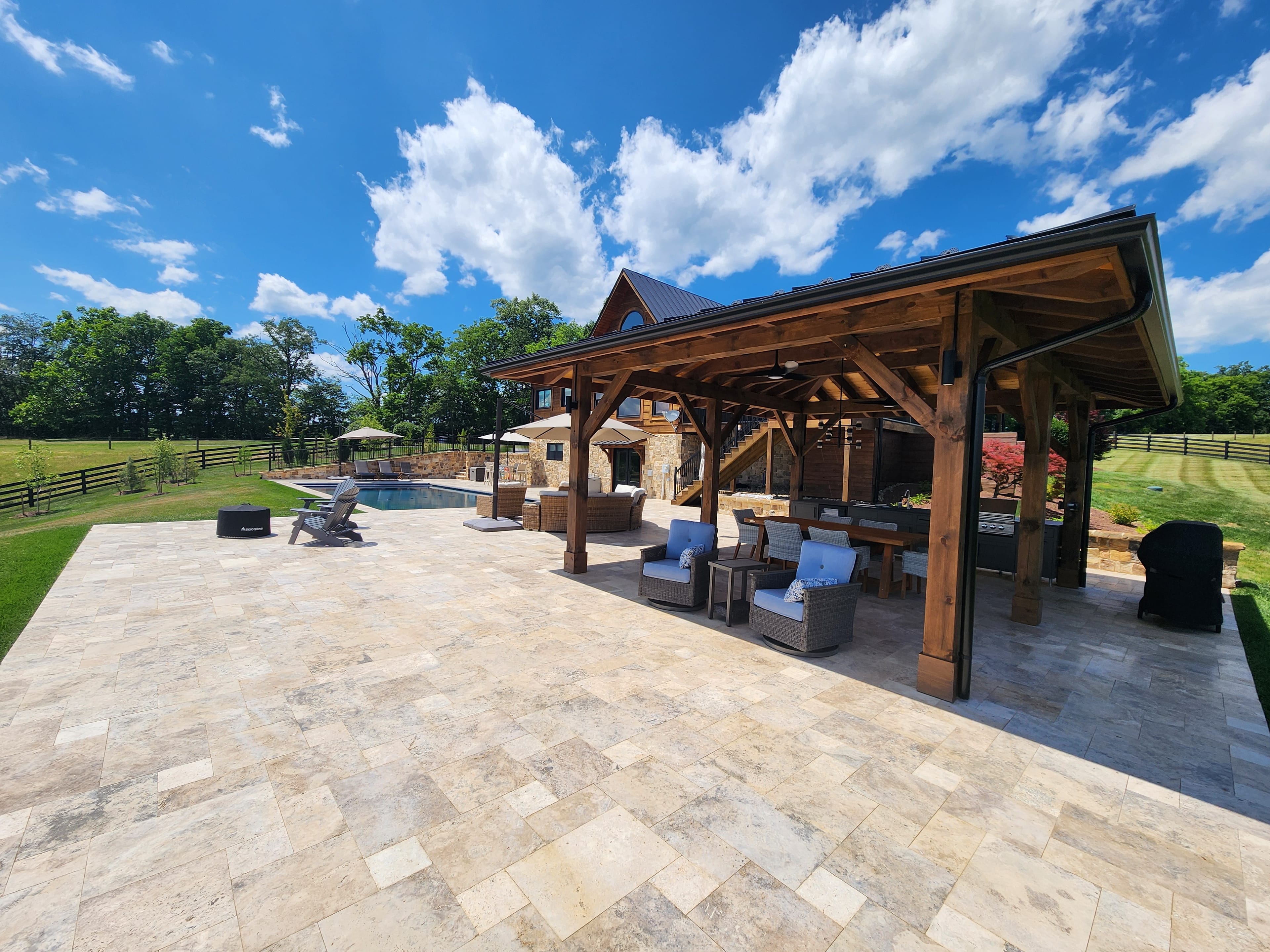
The Winchester pool and patio project uses Philly Travertine French Pattern across open paving and beneath a timber pavilion. The project credits Axel Masonry and Conlon & Sons Construction Co. Its broad field makes the repeat easy to appreciate, while posts and transitions show why the perimeter needs a separate cutting plan.
Ivory Travertine around a curved Leesburg pool
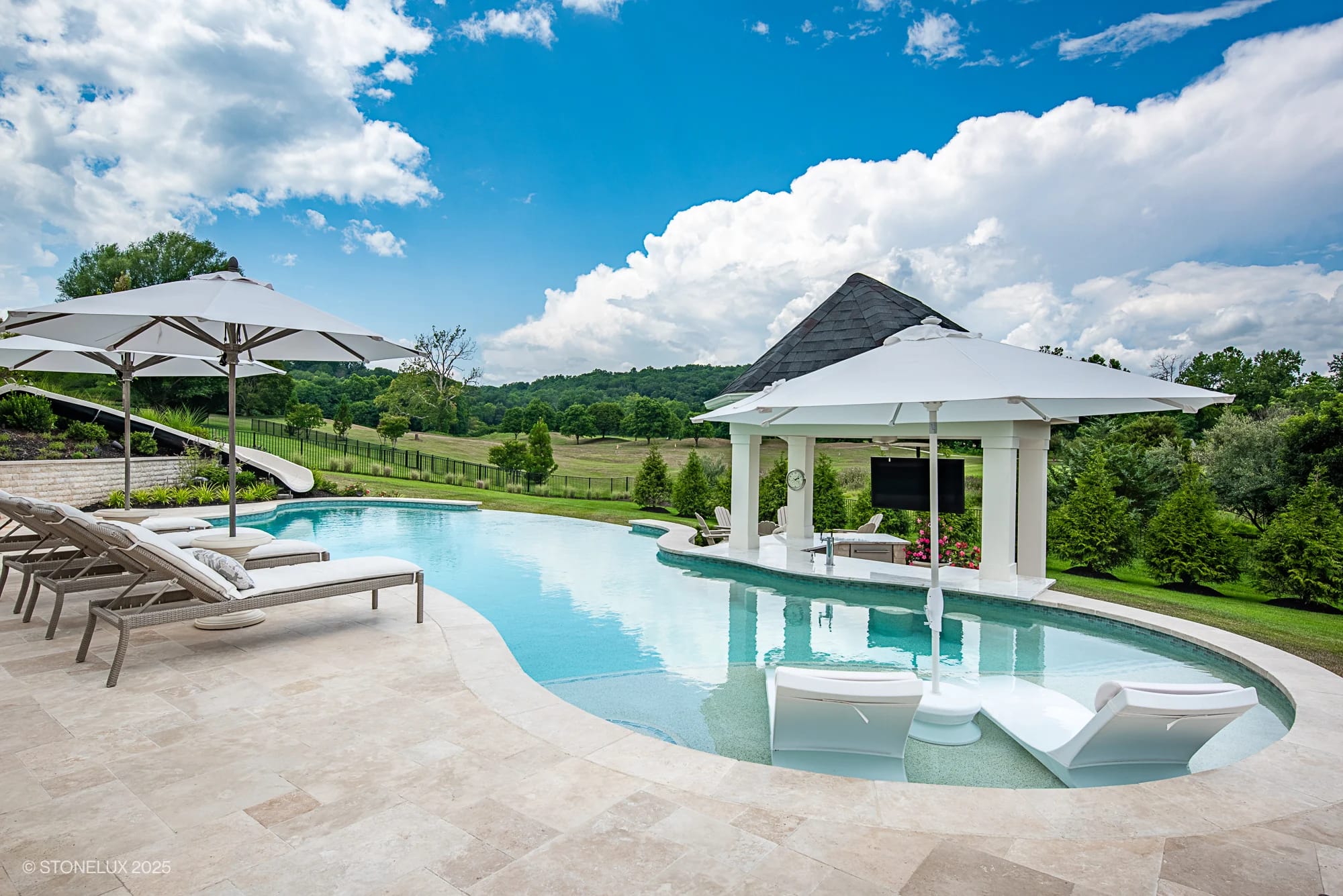
At Leesburg Grecian Oasis, Pristine Acres paired Ivory Travertine French Pattern with matching coping. The sweeping pool outline interrupts the paving field. Plan where the repeat meets the coping instead of treating the curve as a place to use whichever pieces remain.
Silver Travertine connecting steps, pool and spa
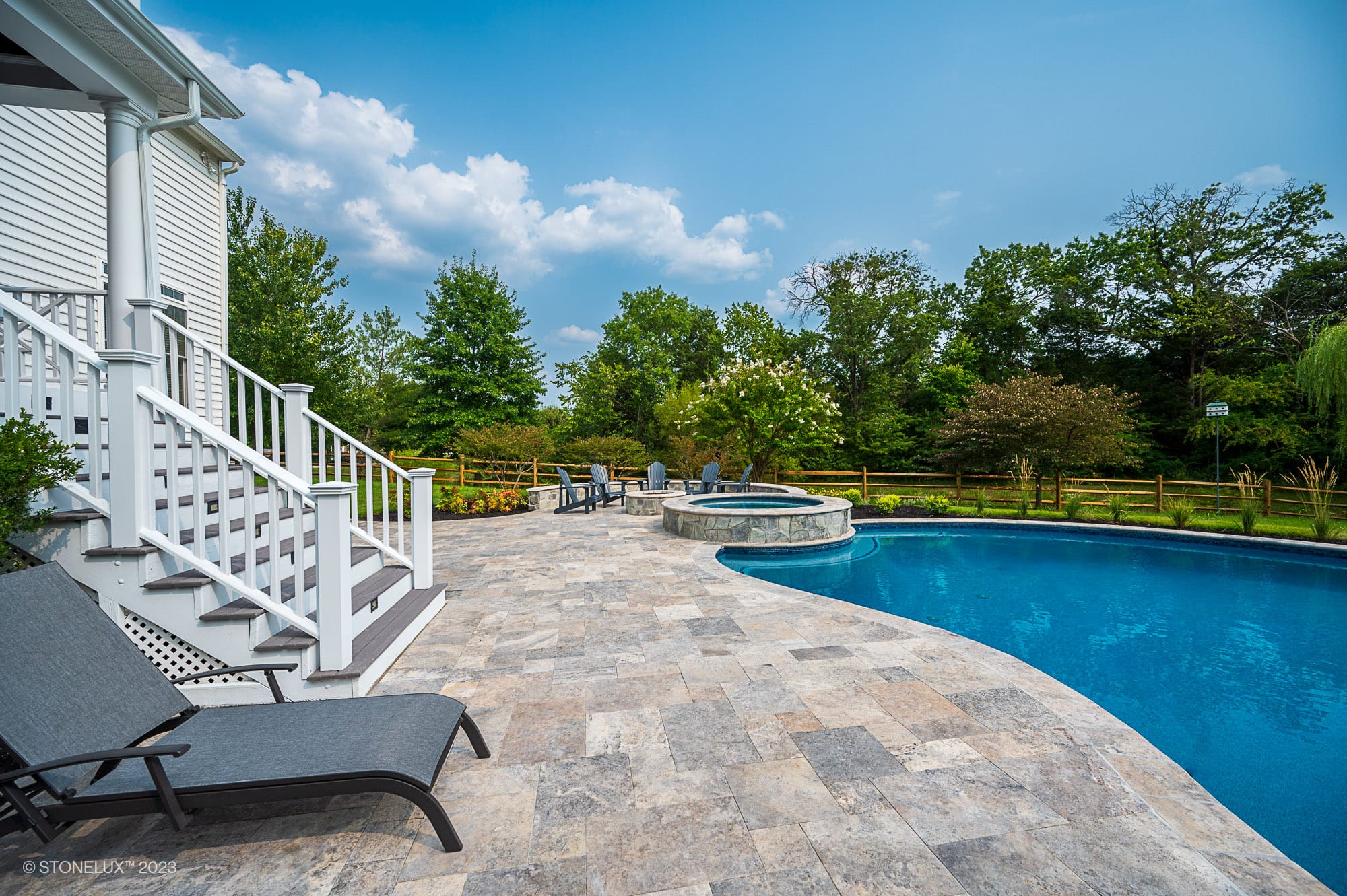
The Silver Splash project in Chantilly by Lewis Aquatech brings Silver Travertine French Pattern around a curved pool, round raised spa and house steps. These competing edges make shared reference lines valuable. Decide which alignment leads and how the adjoining areas reconnect.
Tundra Grey Marble around a rectangular McLean pool
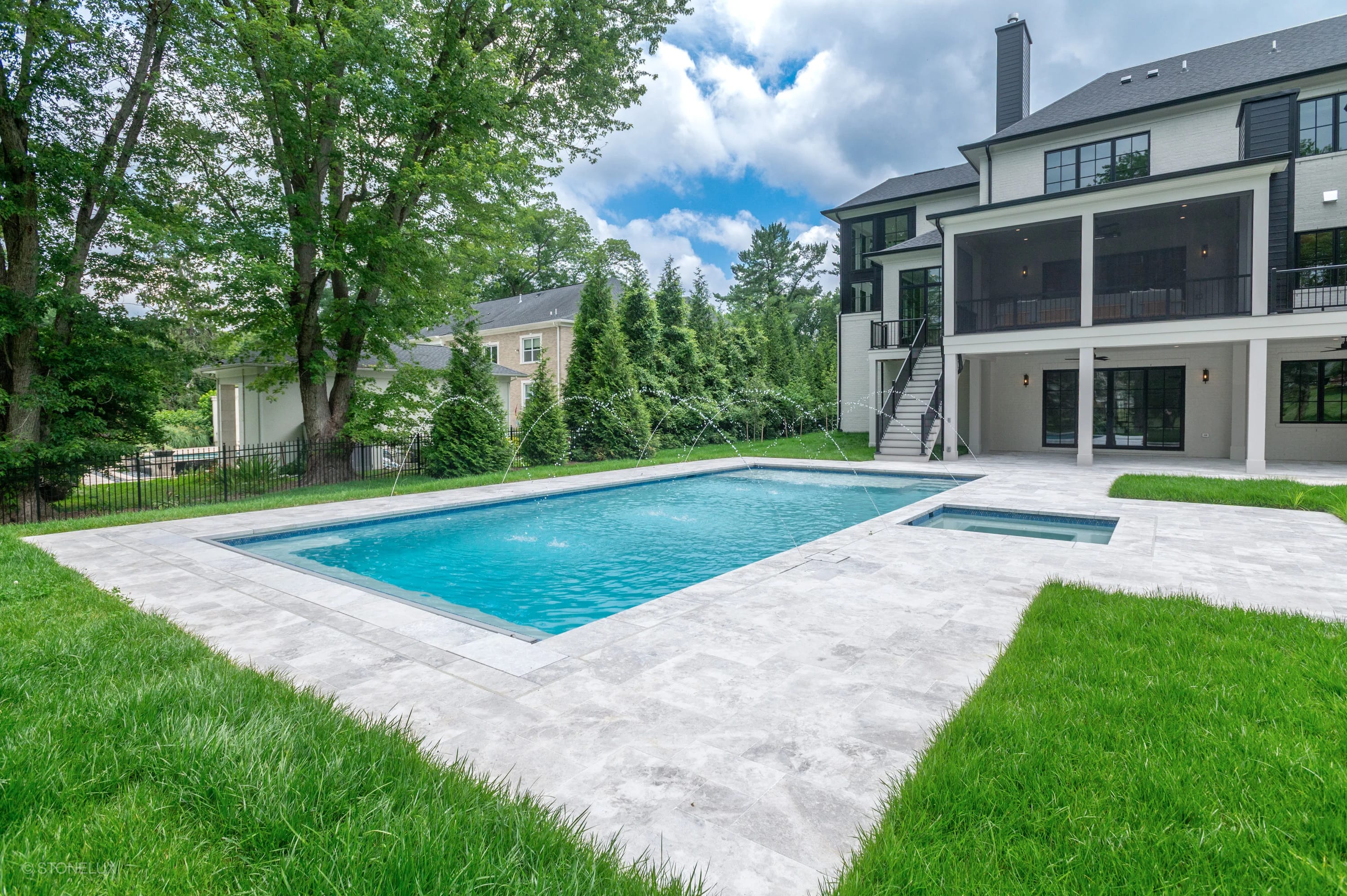
In Tundra Grey Harmony in McLean, French Pattern marble meets matching 2-inch eased-edge coping. The project credits Cherry Hill Custom Homes and Paramount Pools. It shows that a mixed-size field can accompany a straight pool perimeter and a consistent material palette.
For more photographs, explore French Pattern pool deck ideas, travertine pool decks and marble pool decks.
French pattern travertine questions
Is French pattern the same as Versailles pattern?
The names often describe the same family of four-size, interlocking stone layouts. They do not guarantee identical dimensions, joint allowances or packaging. Compare the actual sizes, piece counts and supplied drawing before ordering or combining materials.
Can French pattern travertine be laid randomly?
A custom arrangement is possible, but it needs its own piece-by-piece calculation. Following the supplied repeat is the practical way to maintain the intended size balance. Random placement can exhaust one format while leaving plenty of unusable square footage in other sizes.
Why do two smaller stones fail to line up with a larger one?
Check the actual dimensions and whether spacers were added to a kit intended for tight assembly. Also check that the pieces belong to the same compatible kit. If adjoining repeats still do not fit, stop and ask STONELUX to review the measurements and layout before trimming more material.
Can French pattern work on a narrow walkway?
Yes, but the width may cut through most repeats. Dry-lay the walkway and proposed borders, compare the number and size of cuts, and assess a single-size alternative. A balanced pallet does not guarantee balanced leftovers from a narrow strip.
Should travertine holes be filled when the joints are finished?
Filling surface pits and treating joints are separate decisions. Agree on the intended appearance, compatible filler and installation method before work starts. Do not assume a sweep-in joint product is appropriate for filling the stone face.
Is French pattern suitable for pool decks and cold climates?
The pattern describes the arrangement, not a performance rating. Specify the actual stone and finish for the project’s wet conditions and climate, and review relevant product information with the installer. Drainage, movement joints, maintenance and the installation system matter. Neither a tumbled finish nor sealing makes a surface slip-proof or frost-proof.
Does a 176 sq ft pallet cover 176 finished square feet?
It supplies 176 sq ft of nominal stone area in the stated packing configuration. Cutting, breakage and retained spares reduce the area available for the finished field. Calculate the project allowance before rounding to full pallets; do not treat pallet coverage as guaranteed installed yield.
Plan your French pattern order with STONELUX
For pool builders, contractors, landscapers and designers: compare the selected paver and matching edge pieces together. For a useful quotation, provide:
Net field square footage and the installer’s cutting allowance.
Preferred material, finish and product grade.
Coping linear footage, profile and dimensions; separate border and tread quantities.
Proposed substrate and installation method.
Project ZIP code, required timing, delivery access and unloading needs.
Add products to your quote cart or contact STONELUX to discuss the material schedule.
For homeowners: request samples, save a project you like, and share this layout guide with your installer. You can also visit our Sterling, Virginia showroom to compare materials. Choose the stone and coping together, then confirm the takeoff before placing the order.
Layout and care references
The Bedford Stone layout sheet illustrates the standard 16 sq ft repeat. ORIJIN Stone’s packing guide documents a comparable 176 sq ft configuration. 3D Stone’s layout guide illustrates a kit intended for tight assembly, and Sakrete’s polymeric-sand guidance explains application limitations. These references supplement the drawings; the approved instructions for your supplied stone and installation system control the work.